
The Enhanced Games wrapped in Las Vegas last night. Fred Kerley, one of the most decorated sprinters on the planet, ran the 100 meters in 9.97 seconds. Fully enhanced. Medically supervised. With a million dollars on the line if he broke the world record. He didn’t come close. Three clean athletes won their events outright, competing without any performance enhancing drugs, beating their enhanced competitors anyway. Thor Björnsson couldn’t break the deadlift world record. The one world record that fell across the entire night came in the final event, the men’s 50 meter freestyle, where Kristian Gkolomeev touched the wall in 20.81 seconds. Seven hundredths of a second faster than the existing mark. That earned him the million dollar bonus and gave organizers something to point to after five hours of competition that largely failed to deliver the revolution they promised.
Seven hundredths.
And yet the takes are everywhere. Unethical. Immoral. A betrayal of everything sport stands for. A danger to youth athletes. A desecration.
Here’s what I think. I think the Enhanced Games is the most honest mirror sport has held up to itself in a long time. And most people don’t like what they see in it, not because of what the Enhanced Games is, but because of what it reflects back about the system we’ve built and spent decades pretending was clean.
Let’s start with the premise that’s driving all the outrage: that performance enhancement is the problem. It isn’t. Enhancement is already everywhere. It’s just that we’ve decided some forms are acceptable and others aren’t.
The athlete on the start line of an Olympic 100 meter final who has a world-class strength and conditioning coach, a mental performance specialist, a sports nutritionist, elite sports medicine, sports science, and biomechanical feedback is enhanced. The athlete next to them who came from a country that can’t fund any of that, who trained on raw talent and limited coaching, is competing against a system, not just a person. We don’t call that an integrity problem. We call it the Olympics.
I’ve worked across more than 40 medal campaigns in 30 sports on three continents. The gap between what well-resourced nations provide their athletes and what under-resourced ones can offer is enormous. It isn’t hidden. It’s just acceptable, because the people writing the outrage pieces are mostly from the countries that have the resources. The enhancement is already baked in. We just don’t see it because it’s institutionalized.
And before anyone lands on the argument that performance-enhancing drugs change everything, the results from last night said otherwise. We already knew that athletes who tested positive after winning Olympic and world championship events don’t win by massive margins. There just aren’t massive margins to be gained when you control for developmental resources and infrastructure. Which is why developed countries win the majority of the medals – and enhanced athletes from those same countries, if they win, win marginally. That’s the game. The Enhanced Games is just highlighting one aspect of enhancement.
The athletes who showed up in Las Vegas seemed to be interested in the “what if” scenario. Many of them reached the highest levels the sport has to offer. And at the end of it, with bodies that have absorbed years of training and competition, they’re asking a completely reasonable question: is there anything left, and what happens if we push it further?
The fact that they’re doing it for higher prize money shouldn’t be viewed negatively either. Think about what we ask elite athletes to do and what we pay them for it. A US Olympic gold medal comes with a $37,500 bonus. Training costs in many sports run over $100,000 a year. The United States is one of the only countries in the world that provides no direct federal funding to its Olympic athletes. The USOPC runs on sponsorships and broadcast deals. The athletes run on hope.
We extract everything from them during the pursuit and reward them only at the finish line. And even then, the reward is a medal that embodies their achievement, not something they can take to the bank and use as collateral to purchase a house. In 2026, when a teenager with a phone and a personality can build a bigger platform in six months than an Olympian built in a decade of sacrifice, that starts to feel like a bad deal.
So some of them went to Las Vegas. And we’re calling them the problem.
The people calling them the problem are, in many cases, the same people who have never seen sport beyond their own city, their own country, their own sport. Until you’ve seen it from grassroots to elite, across multiple countries and multiple sports, the responsible position is to observe more and conclude less.
The countries that don’t need slogans about letting kids play have built physical activity into the architecture of daily life – Finland, the Netherlands, Denmark, New Zealand. Physical challenge is woven through the school day so that when kids sit down to learn, their bodies and minds are actually ready to do it. In the United States we went the other direction. We pulled movement out of schools, built liability-proof playgrounds, hovered over kids until they stopped knowing how to navigate risk, then put them into organised sport at six and acted surprised when by twelve they were done.
Here’s the cycle. A kid shows any ability and the adults around them immediately shift. It stops being play. It becomes investment. Travel teams at eight. Specialisation at ten. Year-round training at twelve. Burnout, injury, or quiet exit by thirteen, fourteen, fifteen. We didn’t lose those kids to distraction or laziness. We lost them to a system that optimised for selection before it ever got to development.
Sport doesn’t exist in a vacuum. Everything else in life is enhanced if you can afford it – the right school, the right neighborhood, the SAT tutor, the internship through a family connection. Nobody calls that cheating. But an athlete who uses a medically supervised substance to extract one more hundredth of a second from a body they’ve spent twenty years building? That’s a moral failure. That’s a betrayal of everything sport stands for.
The hypocrisy isn’t subtle. It’s structural. We’ve built entire systems of advantage and called them merit. We accept enhancement in every domain where the people doing the accepting are the ones being enhanced. The moment it moves into a space they don’t control, suddenly it’s an integrity crisis.
And the argument that enhanced athletes send the wrong message to children? That responsibility belongs to parents, not athletes. Athletes – like teachers, politicians, and everyone else visible in a child’s world – are examples. Some good, some bad. That’s not a failure of sport. That’s the human condition. The work of helping children develop the judgment to navigate those examples belongs to parents and coaches. It always has. Delegating it to elite athletes and calling them out when they fall short is a way of avoiding the harder conversation about what we’re actually building at home.
Accept it all, renounce it all, or take the middle path and have some compassion for people caught inside a system that was never designed to serve them.
So how did we get here? We built a sport system that serves the wrong outcomes, compensates the wrong people, and strips the joy out of participation before most kids are old enough to decide whether they actually love the game. We confused selection for development and volume for readiness. We built an ecosystem that extracts everything from athletes – the sacrifice, the years, the physical cost – and returns very little in kind. The adults around kids stopped asking what kids needed and started asking what the system required.
The Enhanced Games isn’t the disease. It’s a symptom. The disease is that broken ecosystem, operating at every level from elite sport down to the six-year-old at their first practice.
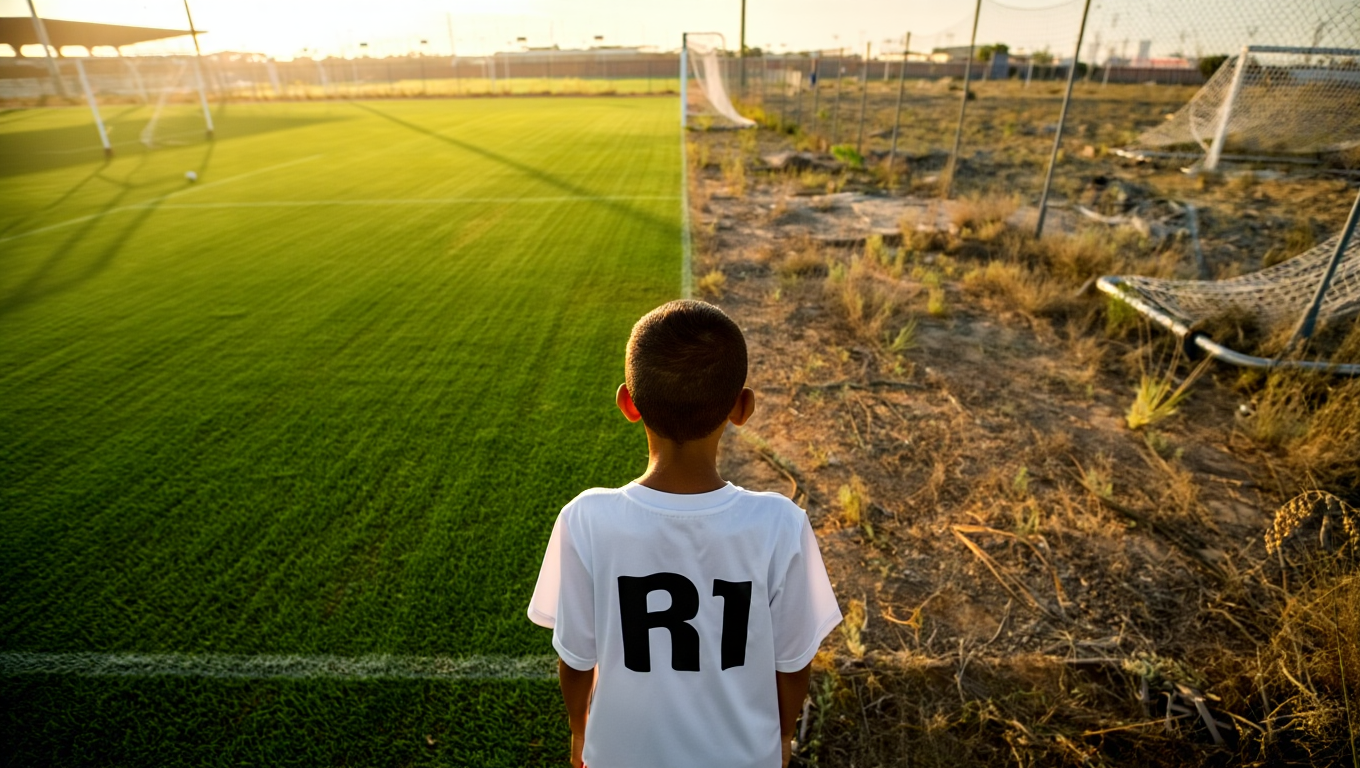
This is why we built R1 ReadyFirst. Not so kids can chase a pathway. So every kid can be ready, whatever that readiness ends up serving. Most of them just need to show up to their day – school, practice, life – with a mind that’s engaged, a body that’s capable, and enough in the tank to handle what’s in front of them. And the adults around them need to understand who they’re actually dealing with on any given day, not who they hope they’re dealing with.
Kids aren’t accidentally athletic anymore. Past generations went outside because outside was more compelling than inside. Adults were just less available, and that turned out to be a gift. You figured things out, you got hurt, you got back up, and you came home when it got dark.
That world is gone. And we haven’t replaced what it gave kids. Their bodies aren’t ready for sport. In a lot of cases, they aren’t ready for the school day. And when we put them into environments that are hard – because sport should be hard, because the world is hard – they don’t have the physical, mental, or energetic foundation to meet the challenge. So they leave.
R1 reads where a kid is every day across Mind, Body, and Energy, and gives them, their parents, and their coaches what they actually need to develop. Not a snapshot. Not a dashboard. A continuous, personalised experience built around the child in front of you, not the athlete you wish they were.
Sport done right is one of the best development environments we have. It’s hard. It’s relational. It exposes kids to pressure and teaches them to respond. It builds identity, belonging, and the kind of confidence that transfers to everything else in life.
But it only works if kids are ready for it.
Ready or not, that work starts now.
See readiness in action.
R1 is building the first national readiness study for youth athletes. Up to 100,000 children across multiple sports.